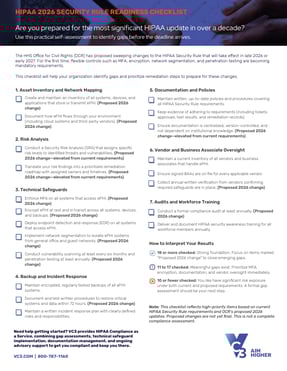
1. Asset Inventory and Network Mapping
⏹️ Create and maintain an inventory of all systems, devices, and applications that store or transmit ePHI. (Proposed 2026 change)
⏹️ Document how ePHI flows through your environment (including cloud systems and third-party vendors). (Proposed 2026 change) .
2. Risk Analysis
⏹️ Conduct a Security Risk Analysis (SRA) that assigns specific risk levels to identified threats and vulnerabilities. (Proposed 2026 change—elevated from current requirements)
⏹️ Translate your risk findings into a prioritized remediation roadmap with assigned owners and timelines. (Proposed 2026 change—elevated from current requirements)
3. Technical Safeguards
⏹️ Enforce MFA on all systems that access ePHI. (Proposed 2026 change)
⏹️ Encrypt ePHI at rest and in transit across all systems, devices, and backups. (Proposed 2026 change)
⏹️ Deploy endpoint detection and response (EDR) on all systems that access ePHI.
⏹️ Implement network segmentation to isolate ePHI systems from general office and guest networks. (Proposed 2026 change)
⏹️ Conduct vulnerability scanning at least every six months and penetration testing at least annually. (Proposed 2026 change)
4. Backup and Incident Response
⏹️ Maintain encrypted, regularly tested backups of all ePHI systems.
⏹️ Document and test written procedures to restore critical systems and data within 72 hours. (Proposed 2026 change)
⏹️ Maintain a written incident response plan with clearly defined roles and responsibilities.
5. Documentation and Policies
⏹️ Maintain written, up-to-date policies and procedures covering all HIPAA Security Rule requirements.
⏹️ Keep evidence of adhering to requirements (including tickets, approvals, test results, and remediation records).
⏹️ Ensure documentation is centralized, version-controlled, and not dependent on institutional knowledge. (Proposed 2026 change—elevated from current requirements)
6. Vendor and Business Associate Oversight
⏹️ Maintain a current inventory of all vendors and business associates that handle ePHI.
⏹️ Ensure signed BAAs are on file for every applicable vendor.
⏹️ Collect annual written verification from vendors confirming required safeguards are in place. (Proposed 2026 change)
7. Audits and Workforce Training
⏹️ Conduct a formal compliance audit at least annually. (Proposed 2026 change)
⏹️ Deliver and document HIPAA security awareness training for all workforce members annually.


 Company
  Team
Team  Local Government Partners
  Case Study
 Company News
  Team Member Spotlight
  Managed IT Services
 Co-Managed
  Managed AI Services
 Managed Security Services
  Co-Managed Security Services
  Data Backup + Disaster Recovery
  Compliance as a Service
  SharePoint
 Power BI
 Web Design + Hosting
 Application Development
 Businesses
  Municipalities
  Local Government Services
  Healthcare
 Manufacturing
 Aerospace and Defense
 Guides
 News
News Events
 Municipalities
 Healthcare
 Managed IT Services
 Compliance
 Cybersecurity